
Near-zero downtime
The stack supports business applications across industries. Every layer, from the Rust server to the application backends, is maintained from source, including code brought in from elsewhere. Security and resilience probes check how the systems respond to attacks and recover from failures.
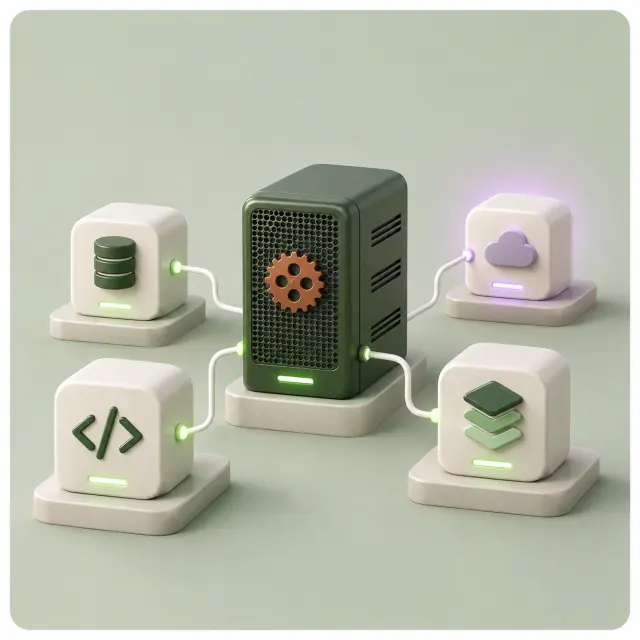
No external source dependencies
The Rust server builds offline from maintained source, with no registry packages.
- Networking
- The Rust server handles HTTP, TLS, WebSockets, and compression. It terminates HTTPS directly and routes requests to the business services.
- Frontend
- The storefront, admin interface, and customer portal build with pinned copies of the in-house compiler and browser runtime. They ship without external packages.
- Applications and data
- DoPOS is the largest project built on this stack. Its Rust backend records orders in PostgreSQL and keeps clients in sync. Terminals send receipts to local printers.
Recent outages and security advisories
Core DoPOS workflows remained available during the provider outages listed here, based on observations at the time.
NGINX security advisory
F5 disclosed vulnerabilities in NGINX. This stack terminates HTTPS directly on the Rust server.
Java4Shell
A vulnerability in OpenJDK prompted a critical update. The order backend runs as a native Rust executable.
Microsoft 365 outage
Exchange Online and features in other Microsoft 365 services were disrupted. The business application handles its own sessions and order processing.
PHP2Shell
The PHP project patched two critical runtime vulnerabilities affecting web deployments. Public ordering requests go to the Rust backend.
ChainDrop npm compromise
ChainDrop, a Shai-Hulud variant, spread across hundreds of npm packages. The Operator lockfile pins keyv 4.5.4 for development. The compromised keyv release was 6.0.0.
HTTP/2 Bomb
The advisory covered resource-exhaustion flaws in several HTTP/2 implementations. The deployed Rust server uses its own HTTP/2 implementation and caps decoded header sizes before allocating memory.
More outages and advisories
AWS connectivity disruption
AWS reported connectivity and sign-in problems in Northern Virginia. Core ordering workflows run independently of the affected services.
Google Cloud London outage
A power disruption in one London zone affected multiple services across the region for about six hours.
Azure gateway disruption
Several Azure networking services experienced failures across multiple regions for five hours and 45 minutes.
GitHub outage
GitHub reported disruptions to authentication, Actions, and other services for seven hours and 47 minutes. Application releases use a self-hosted repository.
More npm supply-chain incidents
The Rust server and the storefront, admin interface, and customer portal build without npm packages.
Shai-Hulud in the Tensorlake SDK
Tensorlake disclosed that its JavaScript SDK release 0.5.144 carried Shai-Hulud. The project lockfiles reviewed for this advisory contained none of the affected packages.
AsyncAPI release compromise
Compromised release workflows published five malicious versions across four AsyncAPI packages, including its generator and specification tooling.
Mastra package compromise
Mastra reported 116 malicious publishes, mostly in its own package namespace.
Miasma and Red Hat Cloud Services
Red Hat disclosed malicious releases in the @redhat-cloud-services namespace and identified the malware as Miasma, a form of Mini Shai-Hulud.
Mini Shai-Hulud and AntV
A separate May wave hit AntV charting libraries and related npm packages. Researchers documented malicious versions across more than 300 packages.
Mini Shai-Hulud and TanStack
TanStack reported 84 malicious versions across 42 Router and Start packages in the May 11 wave.
Mini Shai-Hulud and SAP tooling
An April wave compromised four npm packages used by SAP developers, including the Cloud MTA Build Tool and CAP database modules.
Shai-Hulud’s third wave
A malicious Bitwarden CLI release, @bitwarden/cli 2026.4.0, briefly reached npm during the wider Checkmarx supply-chain incident.
Axios npm compromise
A compromised maintainer account published two malicious Axios versions, 1.14.1 and 0.30.4. Neither version appears in the desktop Operator lockfile.
Shai-Hulud 2.0
The second worm wave compromised hundreds of npm packages, including releases from AsyncAPI, PostHog, and Postman. It targeted credentials used by developers and build systems.
Original Shai-Hulud campaign
CISA reported that the first wave of the self-spreading worm compromised more than 500 npm packages and targeted developer and cloud credentials.
Chalk and Debug compromise
Malicious releases included Chalk 5.6.1 and Debug 4.4.2. The desktop Operator lockfile pins Chalk 4.1.2 and Debug 4.4.3.
Nx s1ngularity compromise
Stolen publishing credentials were used to release malicious versions of Nx build tools to npm. The versions remained available for about four hours.
Security and resilience probes
Probes test how the stack responds to hostile inputs, resource limits, and simulated failures. Specifications or independent implementations provide a reference where available.

Rust server and TLS
Protocol probes check how the server handles malformed input and how TLS validation responds to invalid certificates. An isolated test under process limits checks that the release binary keeps serving valid traffic and accepting new connections.
DoPOS integrations and recovery
The probes use synthetic orders and a disposable PostgreSQL database to check timeouts, duplicate deliveries, transaction rollback, and receiver restarts during simulated marketplace failures.
Formats Suite parser audit
The audit checks how JSON and configuration parsers handle malformed input and behave near depth, stack, and memory limits. It also covers TOML and XML.
Protocol and browser lab
The protocol lab exercises WebSockets, HTTP/3, and QUIC. Real browser workloads check request cancellation, connection reuse, and page behavior under network stress.
Security and uptime in production
Reject ambiguous requests and bound resource use
The Rust server rejects conflicting HTTP framing and checks that the request host matches the TLS connection. It limits connections, headers, and request bodies. Stalled handshakes and idle connections time out.
Check permissions where the data lives
The backend enforces roles and checks the browser's origin and request token before accepting protected changes. WebSocket subscriptions deliver updates only to authorized clients.
Keep one deployment's failure local
Separate application deployments use dedicated processes, private Unix sockets, and PostgreSQL roles. The public Rust server runs as a restricted service. One backend can restart or fail while the others stay reachable.
Keep orders safe when a connection drops
Checkout saves the order and its confirmation together. If the reply is lost, repeating the same checkout returns the saved result. Live updates follow the database commit, so clients can refresh order state after reconnecting.
Treat marketplace orders as external input
The marketplace integration recognizes repeat Lieferando deliveries. When records for the same order conflict, the backend quarantines them for review.
Prepare receipts before the print click
An authorized terminal prepares the receipt for the current order revision before staff click Print. Prepared receipts can go straight to the local spool. If an automatic print has an uncertain outcome, staff review it before printing again.
Validate routes and certificates before applying them
The server validates routing changes before making them active. It checks the names and key on renewed TLS certificates, loads them without restarting, and can continue renewing other certificate groups if one fails.
Verify the executable that goes live
Release records identify the exact Rust source and binary tested under load on the target hardware. Order-processing releases run against isolated copies of business data before activation. Public HTTPS checks follow deployment. Application rollback and database recovery have separate procedures.